Dare to Stand Out – Tags: Authenticity, Awareness, Conformity, L:ife & Legacy, Mindset, Personal Evolution, Self-Acceptance, Self-Discovery, Self-Esteem, The Long Reads
 Life & Legacy | Personal Growth
 The Long Reads • A 6-minute reflection
Or are you obsessed with being part of the herd? Discover the courage required to embrace your unique path and step away from the collective normal.
The Psychology of the Collective Normal
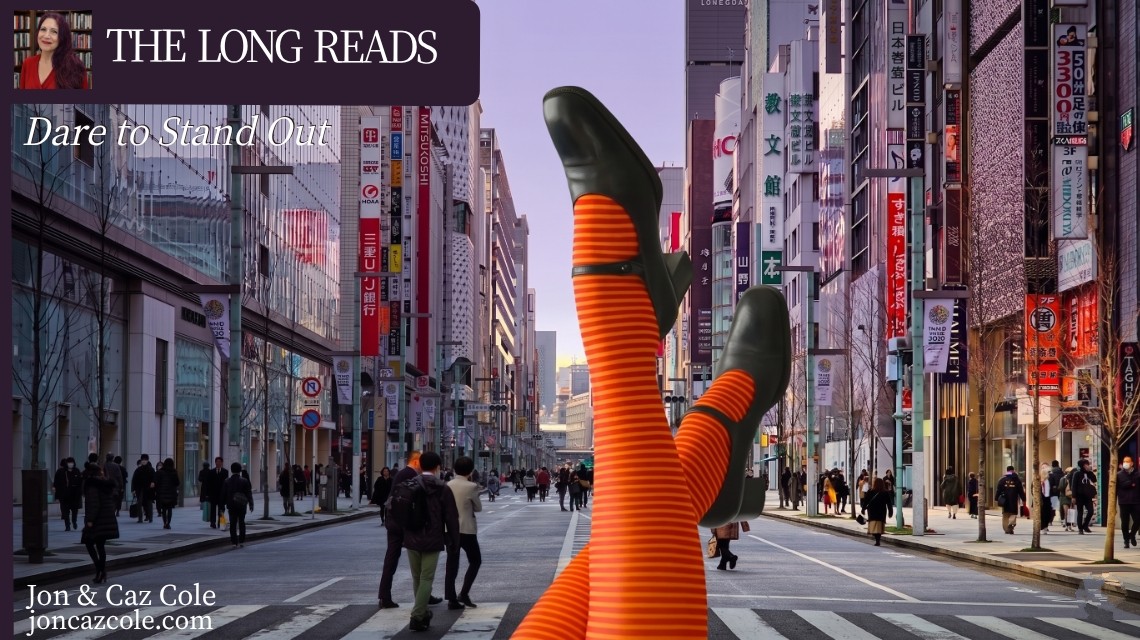
Growth and personal freedom begin when we stop hiding and start showing up as ourselves. Choosing to be different isn’t a rebellion — it’s an evolution. Own your uniqueness, own your power.
Short on time? Jump straight to the Tips to Embrace Being Different for the actionable summary of this article.
‘Don’t wear bright colours,’ my aunt said to her husband.
I was in my teens and wondered about that statement. Later, I found out the reason and was stunned. Let me explain.
My father’s brother, like his parents and siblings, was of Dutch nationality but born in Indonesia — then the Dutch Indies. History buffs will know that the Dutch share a not-so-nice colonial past with the English, with ancestors and descendants being olive-skinned.
It caused many ‘misunderstandings’ during my life, especially where my sister and I have dark hair and (light) olive skin whereas our brother was blond, typical Dutch, you’d say.
I remember in high school, my classmates enquiring after that nice blond guy, and not believing me when I said he was my brother, not my boyfriend.
 Back to the words of my aunt, the Dutch lady who was happily married to my uncle:
‘Don’t wear bright colours because of the colour of your skin.’
She was afraid he’d ‘stand out’ if he wore coloured shirts instead of his standard light to medium blue.
Are we so afraid of being stigmatised? Is standing out that bad? Why is it that most people want to blend in? Fear? A feeling of belonging? Self-worth? FOMO?
The most interesting people are those who do not compromise behaviour, dress code, or contributing to society the Tory way — making money. (A topic for another day: why do we measure people by their economic value?) People who have no FOMO because they live their lives the way they want to. Most importantly, people who do not depend on others for their self-esteem and value.
The Fear of Being Seen
Is it solely a question of confidence? No, it is deeper than that. According to the Wellness website, Exploring Your Mind:
People conform for various reasons: dependence on other people, low self-esteem, lack of motivation, fear… These factors can limit your personal growth and development and prevent you from going above and beyond what’s strictly necessary.
Does that mean that your self-worth is low when you want to fit in? Does it mean you need to work on yourself?
Exploring Your Mind says yes, and I partly agree. Social interactions nowadays sometimes feel like walking on eggshells, trying to avoid being offensive. My view is that while we should always respect others and treat them in the same way we want to be treated, we sometimes erroneously call a sheep a goat, but this doesn’t mean we intend to do so. To me, intention is key.
Back to conforming. We all know that person who has a certain opinion but, once confronted with a different opinion by others in the group, states with tremendous conviction that they had always been of the same mind. You’d almost believe it; they certainly do themselves (another topic for an article!).
Is the Safety of the Herd Worth the Price?
Human beings aren’t destined to live without social contact. It means we conform to the situations we’re placed in. We talk differently to our boss than to our neighbour, to a friend (chosen social contact) or family (not chosen). Up to a certain point, it is perfectly understandable and even desirable that you adapt behaviour to the social environment.
But when your behavioural flexibility turns into a chameleon-like attitude towards (social) life and its communicative challenges, consider why you are doing so.
Is it because you feel afraid people won’t like you when you aren’t of a similar opinion or dressed the way you think you should? Does your self-worth depend on others’ approval?
Think about it. Who are you? Who do you want to be? Could it be that you conform because the distance between who you (think you) are and who you aspire to be is too big even to consider making a single step towards that goal?
Once, when I was younger (quite some years ago), I was sitting in a waiting room. At the time, my self confidence was not the highest, to put it mildly. A woman came in, and the receptionist welcomed her with,’ Oh, my, you have lost some weight! You look great.’ I’d never met either of the women previously. My initial response? She’s lost weight and I haven’t. The receptionist thinks I’m fat. One person complimenting another made me feel a target.
Another example. I’m walking on a pavement in Enschede in the Netherlands, where I grew up. The city centre is quite nice, and I always enjoyed going there. Plus, the library is in the middle of it! Being able to borrow only six books at a time, I visited the library each week. On the other side of the road, I spotted someone I knew. I kept an eye on them, but to my dismay, they didn’t wave or shout ‘hi’.
Had they seen me or deliberately ignored me? Did we have a fallout, or had I done something to make them want to ignore me?
It took me reflection and a painfully honest look into the ‘me’ of years ago to see my responses to social situations, to recognise, much later, how low my self-esteem had been for way too long.
It took me until after I rigorously changed my life to discover who I really was. I released my inner me, the one who’d always been out of reach before, and I felt happy with who I was. Am.
The Slow Erosion of the Self
When we prioritise the herd’s comfort over our own truth, we don’t just blend in — we begin to vanish. Conformity structures our growth towards a “lesser” version of ourselves, moving us further away from our authentic core.
That acceptance of the self made me feel lighter, happier. It gave me confidence in social situations. It made me compliment a stranger on her hat and another’s flamboyant jacket. It made me free to talk to people I didn’t know, and that led to some lovely little chats.
But don’t think it was easy. It takes courage and honesty to look into the mirror of your ‘self’, your soul, and ask yourself: who am I, and how can I improve myself? It’s all about accepting and celebrating who you are with your perks and flaws. All of you.
And you know the benefit? That what other people think about you becomes less important. You can’t please them all — don’t even try!
It wasn’t easy, but I highly recommend it. The journey is not always the nicest, but the feeling of liberation that comes with embracing who you are is truly sensational. It opens up your whole person; it makes you, and that confidence goes with you wherever you go. People will want to engage with you because you radiate positivity. Because they can see you are happy with who you are.
1. Audit the “Herd” Mentality
2. Prioritise Intention over Labels
3. Practise Radical Honesty
4. Release the “Pleaser” Trap
5. Reflect on Your “Enschede” Moments
6. Radiate Your Own Light
Put Insight into Action
Ready to stop blending in? Bookmark our Tips to Embrace Being Different — a one-minute guide designed to help you navigate your journey from conformity to authentic evolution.
So what are you waiting for?